

Event details
- SIPRI, Signalistgatan 9, Solna.
- November 20, 2019
- Wednesday, 13:00PM to 14:30PM
- SIPRI
Contact event manager
Book your tickets
Critical Geopolitics of Climate Change: perspective from Global South
SIPRI Signalistgatan 9 Solna
Wednesday, 13:00PM to 14:30PM
November 20, 2019
000000
SIPRI
Organizer's other eventsCritical Geopolitics of Climate Change: perspective from Global South
SIPRI Signalistgatan 9 Solna
Wednesday, 13:00PM to 14:30PM
November 20, 2019
Emotionally charged, fear-inducing geographies of climate change are steadily proliferating in a climate of fear. There is no doubt that climate has been changing. But climate is not the only thing changing, or changing, for that matter, in complete isolation.
History of the destruction and disappearance of nature in pursuit of primacy and domination, including the colonial chapter, is much longer than the history of global warming. In the context of the complex and dynamic political geography of climate change, the processes of deterritorialisation and reterritorialisation, operating in conjunction, do not so much question the system of sovereign spaces as they reproduce it. Climate as a geopolitical space, therefore, is constantly moving in and out of physical-material geography.
The imaginative geographies of climate change are always in the making, and intermittently assume territorial or non-territorial forms depending upon the strategic convenience of the actors and their agendas concerned. In this new rhetorical map of the earth, the undifferentiated mass of humanity is imaginatively framed as integral to ‘global soul’ and cast within the shadow of a global enemy – climate – which is said to affect all (with the poor and the marginalized as the worst victims) but can only be interpreted and understood by a scientific and economic elite.
Speaker
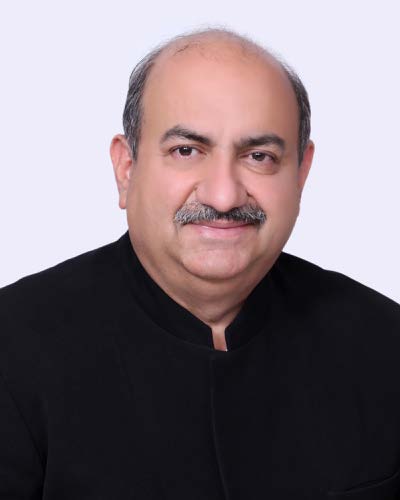 Prof. Sanjay Chaturvedi is Professor of International Relations and Dean, Faculty of Social Sciences at South Asian University, New Delhi.
Background:
Sanjay Chaturvedi has more than 35 years of experience in research and teaching, including post-doc at University of Cambridge, England (1992-1995) with Nehru Centenary British Commonwealth Fellowship, followed by the award of Leverhulme Research Grant.
His research interest revolves around theory and practices of geopolitics, with special reference to Indian Ocean, Polar Regions and South Asia. He is the Chair of Indian Ocean Research Group, Inc. (IORG), currently Observer in the Indian Ocean Rim Association (IORA) and Chief Editor of its flagship journal, Journal of the Indian Ocean Region (Routledge), from January 2020. Regional Editor of The Polar Journal (Routledge), he serves on the editorial/advisory board of several journals including Strategic Analysis (Routledge), Cooperation and Conflict (Sage), India Quarterly: A Journal of International Affairs (Sage), Journal of Borderland Studies (Routledge), Indian Foreign Affairs Journal: A Quarterly of the Association of Indian Diplomats (Prints Publication) and Journal of Global Faultlines (Pluto).
Chaturvedi was elected as the co-chair of Research Committee on Political and Cultural Geography (RC 15) of International Political Science Association (IPSA) for two terms (2006-2009; 2009-2012), and also served on the Steering Committee of the IGU Commission on Political Geography from 2004 to 2012. His publications include co-authored Climate Terror: A Critical Geopolitics of Climate Change (Palgrave Macmillan 2015) and co-edited Geopolitical Orientations, Regionalism, and Security in the Indian Ocean, Energy Security and the Indian Ocean Region and The Security of Sea Lanes of Communication in the Indian Ocean Region (Routledge Revivals, 2015).
For further information please contact Rickard Söder, Tel: 0760 182 724, Email: [email protected]
RSVP by November 18 to [email protected]