
Navigating towards a secure and sustainable future
logo
Mistra Geopolitics
logo
  • About
    • Programme
    • Team
    • Board
    • Partners
    • Stakeholders
  • Geopolitics
    • Background
    • Challenges
  • Research Themes
    • Food security
    • Sustainable Oceans
    • Decarbonization
    • Foresight
  • Our research
    • Publications
    • Research overview
    • Researchers
    • Research School
    • Annual reports
      • Final report 2025
      • 2022
      • 2021
      • 2020
      • 2019
      • 2018
      • 2017
  • Latest
    • News
    • Podcast
    • Events
    • Videos
  • Contact
Comments & Insights
Deciphering the scientific literature on SDG interactions: A review and reading guide
August 12, 2020 by Mistra Geopolitics in Comments & Insights

Authors: Therese Bennich, Nina Weitz, Henrik Carlsen
Abstract

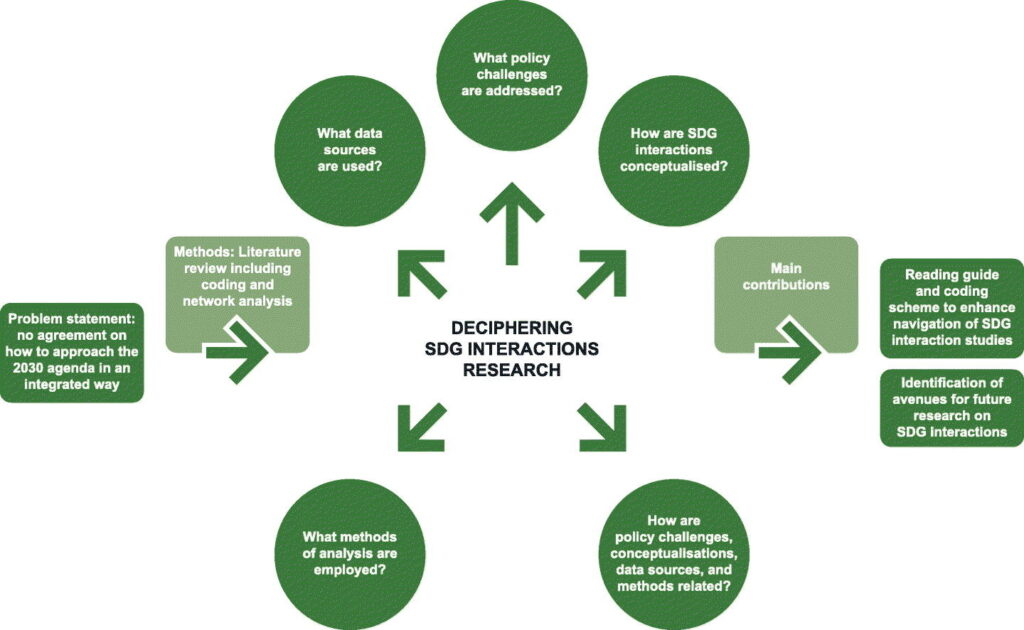
The 2030 Agenda includes 17 overarching Sustainable Development Goals (SDGs). These are integrated in nature, and a principle of indivisibility should guide their implementation. Yet, the 2030 Agenda itself does not provide guidance on what indivisibility means in practice, how the SDGs interact, or on how to assess these interactions. The fast-emerging field of what could be referred to as SDG interaction studies seeks to provide such guidance, but as of yet there is no general agreement on what it means to take an integrated approach to the SDGs. Hence, navigating the diverse research landscape on SDG interactions might prove challenging. This paper aims to decipher the literature on SDG interactions by providing an overview of the current research, based on a sample of 70 peer-reviewed articles. The review explores four themes in SDG interaction research by mapping: (i) policy challenges typically addressed, (ii) ways in which SDG ‘interactions’ have been conceptualized, (iii) data sources used, and (iv) methods of analysis frequently employed. Research gaps are identified, where perspectives largely missing include policy innovation, and integrated monitoring and evaluation. Further, few studies consider actor interactions, account for geographic spill-overs, analyze SDG indicator interactions, employ participatory methods, or take a whole-systems approach to the 2030 Agenda. Failing to address these gaps could lead to inefficient SDG implementation and delay goal attainment. Another contribution of the paper is a reading guide, proposing a way to decipher the literature along the themes emerging from the review, and offering a structure to code future papers.


Download publication >>

Mistra Geopolitics

Latest news

  • New handbook on the Geopolitics of Sustainability March 23, 2026
  • The Nordic region: a geopolitical and environmental hotspot January 27, 2026
  • Mistra Geopolitics Director and researchers among Sweden’s top scholars December 22, 2025
  • EU climate diplomacy and the geopolitics of the Anthropocene November 6, 2025
  • Challenges and opportunities for a globally inclusive and fair energy transition October 23, 2025
  • International SDG-model applied to Sweden by Mistra Geopolitics September 26, 2025
  • The Nordic countries’ approach to the circular economy of metals May 1, 2025
  • Mistra Geopolitics contributes to Mistra’s 30-year celebration in Brussels April 8, 2025
  • Navigating critical mineral sustainability, security and competitiveness April 2, 2025
  • Explore the geopolitics of sustainability with key experts March 31, 2025
logo
© Mistra Geopolitics 2026
logo

We are using cookies to give you the best experience on our website. You can find out more about which cookies we are using or switch them off in .

Contact us Mistra Geopolitics
Powered by  GDPR Cookie Compliance
Privacy Overview

This website uses cookies so that we can provide you with the best user experience possible. Cookie information is stored in your browser and performs functions such as recognising you when you return to our website and helping our team to understand which sections of the website you find most interesting and useful.

Strictly Necessary Cookies

Strictly Necessary Cookie should be enabled at all times so that we can save your preferences for cookie settings. They are usually only set in response to actions made by you which amount to a request for services, such as setting your privacy preferences, logging in or filling in forms. You can set your browser to block or alert you about these cookies, but some parts of the site will not then work. These cookies do not store any personally identifiable information.

3rd Party Cookies

This website uses Google Analytics to collect anonymous information such as the number of visitors to the site, and the most popular pages.

Keeping this cookie enabled helps us to improve our website.

Cookie Policy

More information about Cookie Policy