
On 16 and 17 of November the international conference The Future of Transatlantic Relations: Challenges in Trade, Security and Environmental Policy – FOTAR2018 was held in Hamburg, bringing together politicians, academics, journalists, business and civil society representatives to discuss and exchange ideas about the transatlantic relationship in times of uncertainties and tensions. The discussions probed three areas: Trade and Investment, Environment and Climate, and Peace and Security.
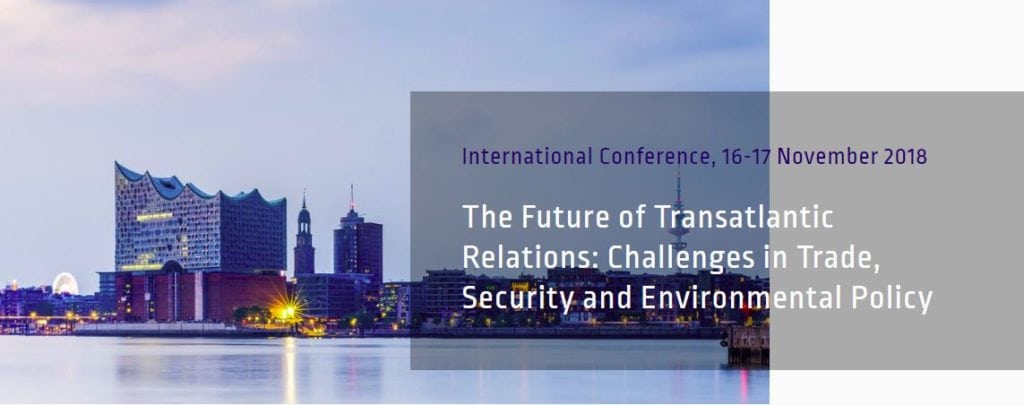
The conference was organised cooperatively by the Bundeskanzler-Helmut-Schmidt-Stiftung and the Europa-Kolleg Hamburg – Institute for European Integration. Mistra Geopolitics researcher Malin Mobjörk was invited to participate in the panel on Environment and Climate where she provided her perspective on climate security.
She shares her reflections from the conference.
How does this connect to your research in Mistra Geopolitics?
As I work with peace and security in connection to global environmental change, I am interested in how notions of security and geopolitics are conceived and configured in international relations. This conference was interesting for two major reasons: First, to listen and reflect on conversations on changes in the transatlantic relationship. Second, to engage with the discussions, particularly regarding the evolution of addressing climate risks. It also enabled me to test my own interpretations and receive inputs from other participants who explore these issues from different backgrounds and perspectives.
What is the most interesting message you take home with you from the conference?
The discussions at the conference repeatedly addressed comparisons between the unique character of the current crisis in the transatlantic relationship with previous disagreements and irritations. Never before have the core values of the relationship been questioned. Nonetheless, several panelists highlighted that some of the controversies today between the US and the EU–namely trade and defence–entail relevant issues to discuss, such as the financial contribution to NATO from European member states. What they question, though, is the way these discussions are performed. Turning to climate policy, the divergences are on another level. The disagreement strikes the core assessment of climate change: how to negotiate, when the President of the US and some of his key officials express doubt of the mere existence of a man-made climate change? The US and the EU are on opposite sides: while the US is stepping down, the EU continues to see itself as a leader of global climate mitigation and aspires to lead the efforts to address the security implications of climate change.
A second recurrent discussion focused on the need to build upon the positive signs, and strengthen relationships and collaborations despite tensions and uncertainties. In climate policy, this means building upon the sub-national alliances that have emerged among US states, cities, companies, and civil society organisations. In relation to climate security issues, it was highlighted that despite heavy budget cuts in climate financing, the US Department of Defense and other federal agencies continue to work on mitigating the adverse effects of climate change. It is crucial to continue to collaborate and develop relations with actors who work on assessing and mitigating climate-related security risks. However, the long-term implications of the current development are worrying and go beyond single policy areas. The uncertainties shaping our time are immense. What is essential is to not let these uncertainties lead to despair and inaction, but to explore them and turn them into visions for a peaceful and sustainable future.
Author: Malin Mobjörk