
Navigating towards a secure and sustainable future
logo
Mistra Geopolitics
logo
  • About
    • Programme
    • Team
    • Board
    • Partners
    • Stakeholders
  • Geopolitics
    • Background
    • Challenges
  • Research Themes
    • Food security
    • Sustainable Oceans
    • Decarbonization
    • Foresight
  • Our research
    • Publications
    • Research overview
    • Researchers
    • Research School
    • Annual reports
      • Final report 2025
      • 2022
      • 2021
      • 2020
      • 2019
      • 2018
      • 2017
  • Latest
    • News
    • Podcast
    • Events
    • Videos
  • Contact
Comments & Insights
Reflections from 2nd annual Mistra Geopolitics conference
February 4, 2019 by Mistra Geopolitics in Comments & Insights
The second annual conference in the Mistra Geopolitics program held on 30 – 31st January 2019, has come to an end. Eva Krutmeijer reflects on the conference from a communications perspective. What have we learnt? How can we strengthen our communications efforts and add value to the program at the same time?
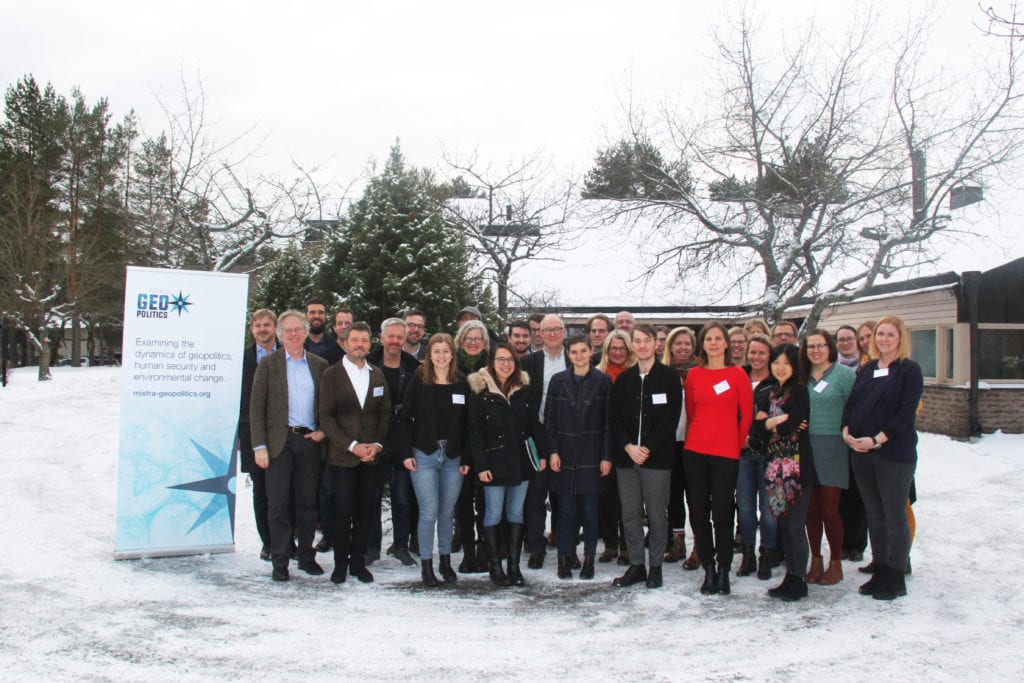
Mistra Geopolitics programme team at the 2nd Annual Conference 2019. Photo: Brenda Ochola/SEI
Eva’s 10 take-home messages:
  1. With cool visualisation tools we can take storytelling to new levels.
  2. Stakeholder dialogues are important processes and by keeping them active we can become even more relevant for our stakeholders and feed into their discussions and strategies.
  3. By using a world map as a backdrop to our research-based stories, it becomes natural to highlight various geopolitical aspects.
  4. Storytelling is a process surrounded by ‘story-shaping’ and ‘story-selling’. Researchers are most important in the first phase – the shaping of the storyline.
  5. The researcher has an important role as an interpreter. This goes in both directions. What does this study imply? How can we understand today’s challenges from our research perspective?
  6. Instead of adding more ideas, we can build upon what we already have. By connecting ideas and findings from our different work packages, our communication can be more relevant to Swedish stakeholders and political decision makers.
  7. By using simple language tools like “on one hand…” and “on the other hand…” in interviews for instance, we can emphasise how an issue can be understood from different perspectives.
  8. We must remember to communicate not only risks and uncertainties, but also opportunities.
  9. When processes move fast, like in international negotiations, it is necessary to maintain the richness and varieties in the various levels of knowledge – we can add geopolitical complexity and trust that policymakers appreciate it.
  10. We can start communicating with unexpected actors, even people and organisations that do not agree with our conclusions at all, and learn from that dialogue.

Author: Eva Krutmeijer

Mistra Geopolitics

Leave a reply

Click here to cancel reply.

Latest news

  • New handbook on the Geopolitics of Sustainability March 23, 2026
  • The Nordic region: a geopolitical and environmental hotspot January 27, 2026
  • Mistra Geopolitics Director and researchers among Sweden’s top scholars December 22, 2025
  • EU climate diplomacy and the geopolitics of the Anthropocene November 6, 2025
  • Challenges and opportunities for a globally inclusive and fair energy transition October 23, 2025
  • International SDG-model applied to Sweden by Mistra Geopolitics September 26, 2025
  • The Nordic countries’ approach to the circular economy of metals May 1, 2025
  • Mistra Geopolitics contributes to Mistra’s 30-year celebration in Brussels April 8, 2025
  • Navigating critical mineral sustainability, security and competitiveness April 2, 2025
  • Explore the geopolitics of sustainability with key experts March 31, 2025
logo
© Mistra Geopolitics 2026
logo

We are using cookies to give you the best experience on our website. You can find out more about which cookies we are using or switch them off in .

Contact us Mistra Geopolitics
Powered by  GDPR Cookie Compliance
Privacy Overview

This website uses cookies so that we can provide you with the best user experience possible. Cookie information is stored in your browser and performs functions such as recognising you when you return to our website and helping our team to understand which sections of the website you find most interesting and useful.

Strictly Necessary Cookies

Strictly Necessary Cookie should be enabled at all times so that we can save your preferences for cookie settings. They are usually only set in response to actions made by you which amount to a request for services, such as setting your privacy preferences, logging in or filling in forms. You can set your browser to block or alert you about these cookies, but some parts of the site will not then work. These cookies do not store any personally identifiable information.

3rd Party Cookies

This website uses Google Analytics to collect anonymous information such as the number of visitors to the site, and the most popular pages.

Keeping this cookie enabled helps us to improve our website.

Cookie Policy

More information about Cookie Policy